Mayors, private sector representatives gather together to make PH cities liveable

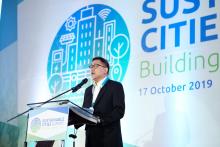
'INVESTMENT opportunities linked to the SDGs are predicted to grow exponentially ahead of other sectors. In the Philippines, the size of the prize is at least $82 billion and 4.4 million jobs by 2030,' Systemiq senior advisor Gail Klintworth said during the "Sustainable Cities Summit: Building Liveable Cities

Liveable cities

Published on October 25, 2019

'INVESTMENT opportunities linked to the SDGs are predicted to grow exponentially ahead of other sectors. In the Philippines, the size of the prize is at least $82 billion and 4.4 million jobs by 2030,' Systemiq senior advisor Gail Klintworth said during the "Sustainable Cities Summit: Building Liveable Cities

Technology important in improving governance — Mayor Binay

The importance of technology in improving governance and bringing officials closer to their constituents were underscored by Makati City Mayor Abigail “Abby” during a forum, Thursday. “I believe that leaders should adapt to the digital age and conceptualize innovative ways to make public services more accessible to our people,” she said in her..

Liveable cities

Published on October 18, 2019

The importance of technology in improving governance and bringing officials closer to their constituents were underscored by Makati City Mayor Abigail “Abby” during a forum, Thursday. “I believe that leaders should adapt to the digital age and conceptualize innovative ways to make public services more accessible to our people,” she said in her..

Liveable Cities Challenge Launch

We are pleased to announce the launching of the Liveable Cities Challenge. The Challenge is a series of competitions among cities to see who can design the best solutions to address a specific problem or "pain point" of their city. This first Challenge is a design competition covering four selected aspects essential to building sustainable, resilient, and competitive cities: Mobility, Resilience, GovTech, and Basic Services.

Liveable cities

Published on October 16, 2019

We are pleased to announce the launching of the Liveable Cities Challenge. The Challenge is a series of competitions among cities to see who can design the best solutions to address a specific problem or "pain point" of their city. This first Challenge is a design competition covering four selected aspects essential to building sustainable, resilient, and competitive cities: Mobility, Resilience, GovTech, and Basic Services.

The Liveable Cities Challenge is open to all 145 Highly-Urbanized and Component Cities in the Philippines. Cities may choose to compete in more than one category by submitting different entries.

The Challenge will run for 90 days from November 2019 to end-January 2020. Entries will be reviewed by a Screening Committee and shortlisted for presentations and pitches to a Board of Judges in February 2020.

To assist cities competing in the Challenge, a pool of Mentors from industry and professional experts will be made available to provide advise and coaching. Design tools will also be made available to universities which form part of city teams in the competition.

Labs and workshops will also be conducted to provide more technical assistance for cities.

We are now receiving applications up to 30 October 2019.

We look forward to having your city join the Liveable Cities Challenge as we work together to create sustainable, resilient, and competitive Liveable Cities.

Download

Liveable cities

The Philippines has had a spotty record of urban planning. What started out as beautifully master-planned cities generations ago have ended up as cities characterized by congestion and traffic, little or poor access to mass transit, few open spaces, parks and public spaces, and many blighted and derelict sections. And yet we’ve also seen some areas beautifully planned and built out in different parts of the country.

Liveable cities

Published on January 19, 2019

The Philippines has had a spotty record of urban planning. What started out as beautifully master-planned cities generations ago have ended up as cities characterized by congestion and traffic, little or poor access to mass transit, few open spaces, parks and public spaces, and many blighted and derelict sections. And yet we’ve also seen some areas beautifully planned and built out in different parts of the country. Whether by design or accident, the parts that have become “liveable” are thriving, booming and driving growth.

Cities are drivers of economic growth and innovation. They are hubs of consumption, resource use and waste. They are also generators of wealth, production and development. The world has been on an urbanization trend for some time now. Over 80 percent of global GDP is generated in cities; 70 percent of greenhouse gas emissions come from cities as well. Over one-half of the people in the world live in cities. And over 30 percent of global city residents live in slums; 75 percent of the global urban population live in a developing country.

For the Philippines, one of the keys to building our national competitiveness is to build city competitiveness. With a population of 105 million people scattered across an archipelago, we need to build liveable cities beyond our three traditional major metropolitan areas of Manila, Cebu and Davao. We need to build 40 to 50 liveable cities.

There are many elements of “liveability,” but in meetings and surveys with mayors, we’ve narrowed down some initial elements to four basic characteristics: Connectivity/Mobility; Resilience; GovTech; and Basic Services.

Connectivity/Mobility would refer to the ability to digitally connect and to move people, goods and services within a city and across cities and the country. Without this, commerce and trade would not be able to grow. This would also include mass transit and other forms of mobility such as pedestrianization, bike-ability and PWD access.

Resilience would refer to a city’s ability to manage itself, prepare and recover in the face of natural calamities, manmade disasters and accidents. Given that we live in a climate-defined future, this will continue to be a major concern for Philippine cities.

GovTech would refer to the digitization of municipal services from both the frontline services and city management points of view. Because most municipal permits (e.g., mayor’s permit, construction permits, occupancy permits, etc.) are still manually applied for and issued, an obvious area of improvement for cities would be to digitize and make these licenses and permits available online, preferably over a smartphone. Moreover, a movement toward “intelligent cities” should lead to improvement in the delivery of services and management of a city.

Finally, Basic Services would refer to such items as power, water, sewerage, telecommunications and other utilities and basic services without which a city could not be considered liveable.

For these reasons, we have established the Liveable Cities Challenge project, to work with city mayors, administrators and planners as well as the private sector to focus on these elements to make cities more sustainable, resilient and competitive. The project will organize Liveable Cities labs, an annual summit, online academy, city dashboards, as well as design, finance and implementation challenges for Philippine cities.

Building liveable cities will bring a number of benefits for cities and the country. The presence of sustainable, resilient and competitive cities creates more potential investment destinations in the country. This, in turn, generates new job opportunities and creates wealth in cities, providing the potential to grow the middle class and to spur more inclusive growth. At the end of the day, it distributes opportunity for growth across the country and provides investors with more options than we currently

Guillermo M. Luz (luz.gm@ayala.com.ph) is an associate director at Ayala Corp. and served as cochair of the National Competitiveness Council from 2011 to 2018. @inquirerdotnet

2016 Liveable Cities Challenge Lab 1: e-Government

Building local competitiveness is essential to enhance long-term national competitiveness. Last July, we re-launched the Liveable Cities Challenge (LCC) with the goal to help cities develop comprehensive, replicable, and implementable solutions to improve their liveability while strengthening local communities in the process.

Liveable cities

Published on December 6, 2016

Building local competitiveness is essential to enhance long-term national competitiveness. Last July, we re-launched the Liveable Cities Challenge (LCC) with the goal to help cities develop comprehensive, replicable, and implementable solutions to improve their liveability while strengthening local communities in the process.

Cities are the primary movers of economic growth and innovation. They are hubs of consumption, resource use, and waste. However, in this increasingly urban world, today’s cities are facing new challenges. They have become the nexus of society’s most pressing economic, social, and environmental issues. For these reasons, we need to plan them better. The Philippines, which is a nation of islands, needs to establish multiple economic hubs—the cities—spread throughout the regions so that we can disperse inclusive growth, opportunities, and development.

One of the challenges in urban development is e-Government. E-Government can be a remarkably powerful and important tool for cities to improve their overall governance. It is an enabler of reforms for governance, from improving systems, purchasing and payment arrangements, sharing of information, and doing business. It is critical to make the delivery of government services more effective. By improving cities’ capacity to provide services, achieve policy goals, and increase efficiency and transparency, e-Government encourages greater trust, participation, and engagement of citizens.

Great cities are not built overnight. But we can get started. In line with its re-launching, LCC conducted the first Liveable Cities Lab last November 17-19 at the Island Garden City of Samal, and Davao City. The event attracted over 60 delegates from 23 cities throughout the regions. The Lab, which focused on e-Government, served as a platform for sharing good practices and innovation on urban development. Experts from Microsoft Philippines and Highly Succeed, Inc. shared their experiences on how technology can be harnessed to improve and enhance the efficiency and effectiveness of government services.

To formally convene the workshop, Tony Lambino of Ayala Corporation and the National Competitiveness Council gave an overview of the Liveable Cities Challenge. Thereafter, Jomari Mercado (Microsoft Philippines’ National Technology Officer) shared examples of e-Government within the Philippines and around the world, including Legazpi City’s Vision 2020, Tagum City’s BPLS and Tax Mapping Program, and Marikina City’s Business Portal. Chie Malaki (Highly Succeed, Inc.’s Business Development Manager) also presented Microsoft’s CityNext, a customizable mobile and web application, which is currently being used in Iloilo and Batangas.

The participants also toured Davao City’s Central 911. The Central 911 facility has grown from being able to address only emergency calls for criminal incidents to having the capacity to respond to almost any type of emergency. Aside from police services, it also caters to emergency medical services, urban search and rescue operations, fire auxiliary services, and K-9 units.

After the tour, retired Gen. Leoncio Cirunay of the Armed Forces of the Philippines showed a video briefing on the Davao Public Safety and Security Command Center (PSSCC). Gen. Cirunay discussed the salient features of PSSCC, and showed the participants how the facility contributed to the growth and development of Davao City.

Subsequently, it was time for the participants to apply what they had learned in the course of the day to their own cities and pain points. The participants were tasked to propose an e-Government solution to the problems/challenges they have in their cities. Participants were then clustered together based on their proposed solution/project: Ease of Doing Business, Public Safety, Security, and Disaster Risk Reduction and Management, and City Services Automation. The clustering facilitated the exchange of ideas, experiences, good practices, and challenges. Jomari and Chie assisted the participants on this matter.

To end the workshop, Conrado Baluran, Coucilor-3rd District Davao City, delivered Mayor Sara Duterte’s message to the participants citing “we should continue to learn from each other to strengthen our communities and make our cities more liveable.” Usec Gil Beltran of the Department of Finance also expressed during his speech the importance of e-Government in enhancing the services of the local government units for its constituents. The participants also received Certificates of Participation, which were presented by Councilor Baluran and Mayor Francis Garcia of Balanga City, the Secretary General of the League of Cities of the Philippines (LCP).

Tony presented the learnings and insights gained from the workshop during the General Assembly of the LCP, held on 19 November 2016. He also presented the next steps and the timeline for LLC. Mayor Ed Pamintuan of Angeles City, the President of LCP, expressed his continued support for the initiative.

The first Liveable Cities Lab was organized by the National Competitiveness Council, Ayala Corporation, League of Cities of the Philippines and Microsoft.


Liveable Cities Challenge launched to promote better urban planning

Today, the Liveable Cities Challenge (LCC) was launched at the League of Cities’ 63rd General Assembly at Crowne Plaza Hotel in Ortigas. The challenge was opened to all cities in the country.

Liveable cities

Published on November 11, 2016

Today, the Liveable Cities Challenge (LCC) was launched at the League of Cities’ 63rd General Assembly at Crowne Plaza Hotel in Ortigas. The challenge was opened to all cities in the country.

LCC is a medium-term program (2016-2019) to promote and enable better urban planning and implementation for cities in the Philippines. The program will include a competition for design, financing, and implementation of urban projects in Resilience, Mobility, E-Government, and other aspects of urban life. It will also include regular Technical Workshops, Site Visits, Networking, and Technical Assistance provided through the Liveable Cities Challenge Consortium led by the National Competitiveness Council, League of Cities of the Philippines, Ayala Corporation and almost 20 other organizations and institutions.

Iloilo and Cagayan De Oro Tops the First Liveable Cities and Design Challenge 2014

Last October 15, 2014 at the Philippine International Convention Center, the Liveable Cities Design Challenge held its Final Conference and Awards Ceremony.

Liveable cities

Published on October 30, 2014

Last October 15, 2014 at the Philippine International Convention Center, the Liveable Cities Design Challenge held its Final Conference and Awards Ceremony. Attended by approximately 160 local government officials, national government representatives, officials of international development institutions, civil society, the academe, and the private sector, the Final Conference and Awards Ceremony celebrated the efforts of the 15 participating cities in the inaugural competition, particularly their design proposals that sought to mainstream liveability and resilience in land use planning and architectural design. Iloilo City was declared the winner of the APEC Meeting Venue category, among a list of finalists that included Legazpi City and Cebu City. For the City Government/Evacuation Center category, Cagayan de Oro City was recognized as the winner. The finalists for this category were Valenzuela City, Zamboanga City, and Roxas City. The other participating cities in the inaugural competition were the City of San Fernando, La Union, Olongapo City, Angeles City, Marikina City, Bacolod City, Tacloban City, Ormoc City, and Baybay City.

The National Competitiveness Council, together with the Alliance for Safe and Sustainable Reconstruction (ASSURE), the Urban Land Institute, Asia Society Philippines, the APEC 2015 National Organizing Council, and the World Wide Fund for Nature, along with the United States Agency for International Development (USAID) and Microsoft Philippines, launched the competition last March 2014 during the second annual meeting of the Pacific Cities Sustainability Initiative. Given how typhoon Yolanda exposed the vulnerability of Philippine urban centers, and recognizing the need for cities to enhance their liveability, the competition sought to encourage city planners to plan and design with resilience in mind, while also addressing concerns for convenience, livelihood, lifestyle, sustainability, and safety.

In his welcome remarks, Mr. Guillermo Luz, Private Sector Co-Chairman of the National Competitiveness Council, provided the participants a short background about LCDC. He shared that the competition provided an opening for technical assistance with cities, which was spearheaded by the architect/planners of ASSURE. Mr. Luz also detailed the process of evaluating the entries of all participating cities, based not only on aesthetics and form, but equally important, the manner through which the entries mainstreamed principles of liveable, resilient, sustainable, and competitive urban growth. He said that, “the Philippines doesn’t need just one great city – it needs around 20 to 25.” Reflecting the overall motivation of the competition, Mr. Luz added that, “good design is not just about the aesthetic but the service to the people.”

In her message, Ms. Gloria Steele, Mission Director for the Philippines and the Pacific Islands, congratulated all of the participating cities for their efforts to come up with innovative designs. She recognized the hard work that all of the teams and shared the continuing commitment of USAID towards inclusive economic growth, especially given, “the strategic importance of Philippine cities”.

Mayor Jed Patrick Mabilog of Iloilo City receives the award for First Place for the APEC Meeting Venue category from Ms. Gloria Steele, USAID Mission Director. They are joined by Atty. Arnel Casanova of BCDA (third from right) and Mr. Carlos Rufino (extreme right)

The Liveable Cities Design Challenge

Today’s City is facing a new challenge. Aside from rapid urbanization, congestion, the need for mass transit, water resources, power, better law enforcement and public services, the City now faces the challenge of a climate-defined future. In recent years, climate change and natural disasters have become the one, unpredictable variable which has affected cities.

Liveable cities

Published on March 18, 2014

Today’s City is facing a new challenge. Aside from rapid urbanization, congestion, the need for mass transit, water resources, power, better law enforcement and public services, the City now faces the challenge of a climate-defined future. In recent years, climate change and natural disasters have become the one, unpredictable variable which has affected cities. From climate events such as typhoons, monsoon rains, and floods to natural calamities like earthquakes and volcanic eruptions, cities across the Philippines have fallen under greater risk and disruption.

This disruption has come in the form of human loss, economic loss, and lost productivity. Storms such as Agaton (2014), Yolanda (2013), Pablo (2011), Sendong (2010), Ondoy (2009), and two earthquakes such as Bohol(2013), Baguio (1990), and volcano eruptions, Mayon (1993), and Pinatubo(1991), have struck across the country, causing great havoc in the affected areas.

Preparing for a climate-defined future

The Liveable City Design Challenge, organized by the National Competitiveness Council, APEC 2015 National Organizing Council, World Wildlife Fund, and the Alliance for Safe and Sustainable Reconstruction (ASSURE) with Asia Society and the Urban Land Institute, is a planning and design competition whose objective is to get city planners across the Philippines to better plan their respective cities and municipalities for a climate-defined future by being more aware and better prepared for disaster-risk reduction. The first of its kind, city planners will be encouraged to design Liveable Cities that offer safety, convenience, livelihood, lifestyle, and sustainability that attract people to live, work, and play so their cities can be competitive.

"By launching this Design Challenge, we hope to start a movement for better urban planning across the country to make our cities fun, vibrant, and safe places to live, work, invest in, and visit. In order to build a competitive country, we need to build competitive cities," according to Guillermo M. Luz, private sector co-chairman of the National Competitiveness Council and a member of the APEC National Organizing Council.

Eighteen cities and municipalities have accepted their invitations to join the competition – Angeles, Bacolod, Baguio, Baybay (Leyte), Butuan, Cebu, Cagayan de Oro, Iloilo, La Union (San Fernando), Legazpi City, Marikina, Olongapo, Ormoc (Leyte), Surigao, Tacloban, Valenzuela and Zamboanga City. Cities will include those hosting APEC Meetings in 2015 and others that are vulnerable or have been affected by disasters in the past.

Competition teams representing these cities must come up with a Strategic Vision and Plan for a Resilient and Liveable City and select one of two competition categories: 1) Developing a Disaster-Resilient Government Center or 2) Developing an APEC Meeting Venue.

The Liveable Cities Design Challenge is sponsored by USAID, which has been supporting the Cities Development Initiative programs like Project INVEST in three cities across the country. USAID is expected to add more local government units to the program when it launches Project SURGE later in 2014.

The Design Challenge has also received sponsorship support from Microsoft, which will build the crowdsourcing website for the competition teams and make available its CityNext mobile application.

Involving Public Insight

The challenge also aims to incorporate the ideas and plans of Filipino citizens who are interested in helping create a disaster-resilient and sustainable city. Submissions will be open on the Liveable Cities Challenge website for a certain time period where the public can submit their proposals to the city of their choice for the competition team’s review. A Public Choice award will be awarded at the end of the competition for the city with the most votes. For more updates and information, follow the challenge on facebook (Liveable Cities Design Challenge Philippines) and twitter (@LCDCPhilippines).

Phases of the Competition

Cities or municipalities that accept the invitation will have to commit to the three phases of the competition. The first phase involves participation in the Pacific Cities Sustainablities Initiative Forum from March 11-13, 2014, where the competition teams will be oriented on essential principles in liveable city planning and engage in a dialogue on urban planning and design with experts rom around the world.

Carlos Rufino, President of Urban Land Institute – Philippines states, "The holding of the PCSI Forum in Manila is timely and provides a wonderful opportunity for our Mayors and City Planners to meet international experts."

The second phase entails working with a team of mentors to develop planning and design concepts for their respective cities. A team of mentors provided by ASSURE, will travel to their respective cities for field visits and mentoring missions throughout the mentoring stage.

The third phase is where the competition teams will finalize their designs for review of the judges. They will be submitting their conceptual designs, architectural perspectives and site plans for final evaluation.

The Design Challenge will bring together a Philippine and international panel of judges to review submissions. Entries will also be displayed in a mall and placed online on the competition’s website for public viewing. Winning entries may become eligible for inclusion in a multi-year technical assistance program of USAID.

Guillermo M. Luz (gm.luz@competitive.org.ph) is private-sector cochair of the National Competitiveness Council.

Watch Our Liveable Cities Labs

Watch Now